Dr. Mohamed Moussa Emara: “We Aim to Restore Confidence in Technical Education… and the Accreditation Standards Will Not Be Just Words on Paper”
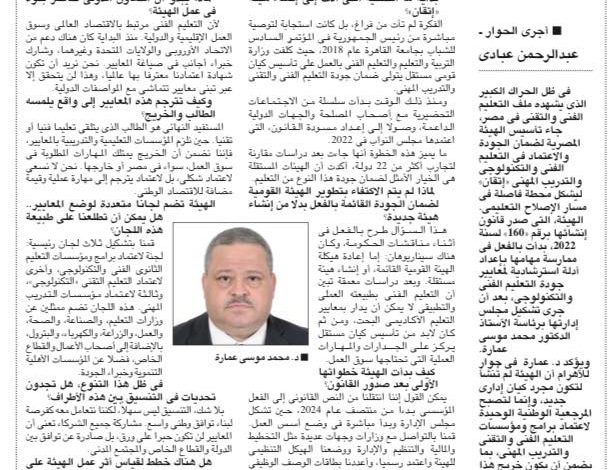
Dr. Mohamed Moussa Emara: “We Aim to Restore Confidence in Technical Education… and the Accreditation Standards Will Not Be Just Words on Paper”
Among significant developments in technical and technological education in Egypt, the establishment of the Egyptian TVET for Quality Assurance and Accreditation Authority (ETQAAN) marks a turning point in the path of educational reform. Established under Law No. 160 of 2022, ETQAAN began its work by preparing guidelines for quality standards for technical and technological education quality standards, under the leadership of Prof. Dr. Mohamed Moussa Emara, Chairman of the Board.
Dr. Emara emphasizes in an interview with Al-Ahram that ETQAAN was not created merely as an administrative body but as the sole national reference for accrediting programs and institutions in technical, technological and vocational education, ensuring that graduates are qualified to enter local, regional, and international labor markets based on competency and quality.
“He also spoke about the establishment of the Authority, the key achievements accomplished so far, and the challenges it faces ahead.”
“To begin with, what were the reasons and background that led to the establishment of ‘ETQAAN’ Authority?”
The idea to establish ETQAAN originated from a direct recommendation by the President of Egypt during the 6th Youth Conference at Cairo University in 2018, tasking the Ministry of Education and Technical Education with creating an independent national entity to ensure quality in technical, technological education and vocational training.
Since then, preparatory meetings with stakeholders and supportive international partners led to the draft law, which was approved by the Egyptian Parliament in 2022.
What distinguishes this step is that it came after comparative studies of the experiences of more than 22 countries, which confirmed that independent authorities are the optimal option for ensuring the quality of this type of education.
“Why was the existing National Authority for Quality Assurance not simply developed instead of establishing a new authority?”
This question was indeed raised during government discussions, and two scenarios were considered: either restructuring the existing National Authority or establishing an independent one. After in-depth studies, it became clear that technical education, by its practical and applied nature, cannot be governed by purely academic education standards. Therefore, it was necessary to establish an independent entity that focuses on the competencies and practical skills required by the labor market.
“How did the Authority begin its initial steps after the law was decreed?”
ETQAAN’s initial steps began in mid-2024, with the formation of the Board of Director, which immediately began laying the foundations for its work. We communicated with several ministries and entities, such as Planning, Finance, and Central Agency for Organization and Administration, establish the Authority’s organizational structure, which was officially approved, and prepared job description cards for the various grades. We also received the official headquarter at the Information and Decision Support Center in Haram in March 2025.”
“What are the most prominent achievements realized during that period?”
There are two main axes:
- Establishment: Preparation of financial and administrative bylaws, human resources policies, and organizational structures have been finalized.
- Operation: Preparation of accreditation standards for programs and institutions across technical and technological education and vocational training, leveraging local and international expertise, conducting intensive workshops, and training staff in review processes. In fact, seven participants have successfully earned International Reviewer Certification.
“Why does international collaboration seem to be strongly present in the work of the authority?”
International collaboration has been central to ETQAAN’s work, recognizing that technical education is closely linked to the global economy, regional and international labor market, From the beginning, there has been support from the European Union, the United States, and other partners, as well as foreign experts participated in drafting the standards. We want our accreditation certificate to be recognized internationally, and this can only be achieved by adopting standards that align with international specifications.”
And how are these standards translated into reality that students and graduates can experience?
The ultimate beneficiary is the student receiving technical or technological education. When we require educational and training institutions to comply with these standards, we ensure that graduates possess the skills needed in the labor market, both in Egypt and abroad. We are not aiming for formal accreditation only, but for accreditation that transferred into practical skills and adds real value to the national economy.
The authority has multiple committees to set the standards… can you explain the nature of these committees?
We have established three main committees: one for accrediting programs and institutions of secondary technical education, another for accrediting technological education, and a third for accrediting vocational training institutions. These committees include representatives from the Ministries of Education, Industry, Health, Labor, Agriculture, Electricity, and Petroleum, in addition to business owners and the private sector, as well as developmental civil society organizations and quality assurance experts.
With such diversity, do you face challenges in coordinating between these parties?
Undoubtedly, coordination is not easy, but we treat it as an opportunity to build broad national compromise. The participation of all stakeholders ensures that the standards are not just words on paper, but a result from agreement between Egypt, the private sector, and civil society.
Are there plans to measure the impact of the authority’s work in the near term?
Yes, we have guiding documents outlining acceptable performance levels. Over the next two years, we will have the first batch of institutions accredited according to the standards, which will serve as the true test of ETQAAN.
Finally… how do you see the future of “ETQAAN” over the next five years?
I predict the authority becoming the sole national reference for accrediting technical, technological education and vocational training. We will be able to ensure that every institution operates according to quality standards. Most importantly, we will restore confidence in this type of education so that it becomes a primary choice for young people, not just an alternative, and we will produce generations capable of competing locally, regionally, and internationally.